ATS Score Meaning: What Is an ATS Score and Should You Rely on It?
A clearer explanation of what ATS score usually refers to, why those numbers vary so much, and how much weight they deserve when you are improving a resume.
TLDR: ATS score is a rough tool signal, not a universal truth
An ATS score usually means a number shown by a resume checker, scanner, or job-match tool. It is supposed to estimate how well your resume fits a job description or how readable it is for software.
The problem is that there is no single universal ATS score used across all applicant tracking systems. Different tools use different assumptions, different weighting, and different parsing logic. Many real ATS platforms do not even show job seekers a score in the first place.
What does ATS score mean in practice?
ATS score usually means, "This tool thinks your resume matches its rules to this degree." Those rules may include keyword overlap, section headings, formatting preferences, or the tool's own opinion about what a strong resume should contain.
That can still be useful. A checker may catch missing keywords, unclear headings, or formatting issues that are worth fixing. But the score itself should be treated as a rough diagnostic, not as an official grade from the employer's system, especially since most of the ATS systems on the market don't offer a public way to check your score.
Why ATS scores disagree so much
A lot of resume websites talk about ATS score as if it were a credit score for resumes. That framing is misleading.
First, many ATS platforms do not expose a score at all. Some systems are mainly databases and workflow tools. Others help recruiters search, filter, tag, and review candidates without ever showing the applicant a public number.
Second, among tools that do score, rank, or match candidates in some way, the logic is usually proprietary. The vendor does not publish exact weighting, field handling, or matching rules. That means different tools can look at the same resume and arrive at very different conclusions.
We ran an experiment by using the top search engine results for "free resume ATS score". A few of the top results just showed a sign-up page or a different kind of bait-and-switch page and didn't deliver what they promised, but from the few that did, none resulted in the same score.
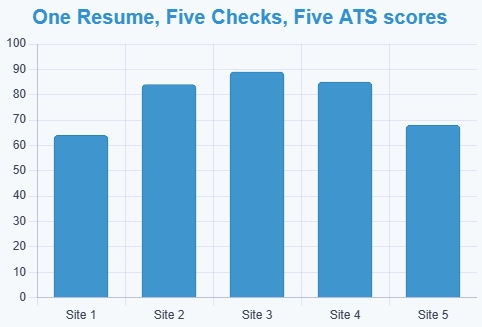
The labels are anonymized on purpose. The same sample resume produced five noticeably different scores across five third-party checkers.
| Checker | Score |
|---|---|
| Site 1 | 64/100 |
| Site 2 | 84/100 |
| Site 3 | 89/100 |
| Site 4 | 85/100 |
| Site 5 | 68/100 |
Those numbers can all be different without proving that one tool is "correct", or "wrong". They are measuring different heuristics, different job-description matching rules, and different assumptions about formatting or wording.
Should you rely on ATS score?
Rely on the feedback more than the score. If a checker points out a missing skill you really have, a vague summary, or a formatting issue that makes text extraction worse, that may be useful.
Do not rely on the score as if it predicts whether you will get an interview. A high number does not guarantee anything, and a lower number does not automatically mean your resume is bad. Some tools push job seekers toward awkward keyword stuffing or overconfidence in a number that is not tied to the employer's actual system.
A better goal is to make sure your resume is readable, relevant to the target job, and written with clear evidence of your skills and results.
Start with the right foundation
If you want the underlying formatting question first, read ATS Friendly Meaning. If you want a cleaner document to improve in the first place, try our free resume builder.
Create Your Resume for Free